
Framework is reshaping today’s $260B knitwear market using software-defined manufacturing. Using 3D-knitting technology and robotic systems, Framework eliminates inventory and supply chain risk to achieve cost parity with Asia and bring clothing manufacturing back to the US.
Framework Automation, founded by Denver Rayburn, builds software-orchestrated, automated apparel factories in the United States to reindustrialize textile production.
The Beautifully, Wonderfully Dissatisfied Consumer
"Customers are always beautifully, wonderfully, dissatisfied," Jeff Bezos wrote in his 2016 letter to shareholders. "Even when they don't yet know it, customers want something better." This is the crux and the curse of consumerism. Consumers always want more, cheaper, and better. New technologies create openings for new entrants to satisfy that infinitude of preference while undermining the cost structure of incumbents.
Consider YouTube versus Netflix. In 2025, Netflix will spend roughly $18B on original content. YouTube will produce none of its own. Yet YouTube will capture 12.5% of US TV viewing time versus Netflix's 7.5% [link]. YouTube's globally distributed creator base produces a perpetually expanding catalog that maps to near-infinite consumer preference. Netflix produces costly inventory and is forced into mass-market appeal, like the studios it replaced.
Different people want different videos. Different people also want different clothes. When new technologies emerge that make it possible to serve that diversity at scale, new businesses with new cost structures move in and dominate the industry. We believe that is about to happen in clothing.
The Cost Physics of Reindustrialization
To understand the shift, you have to understand the cost structure of industrial processes. Framework's CEO Denver Rayburn lays this out in the company's manifesto, Cost Physics & Reindustrialization.
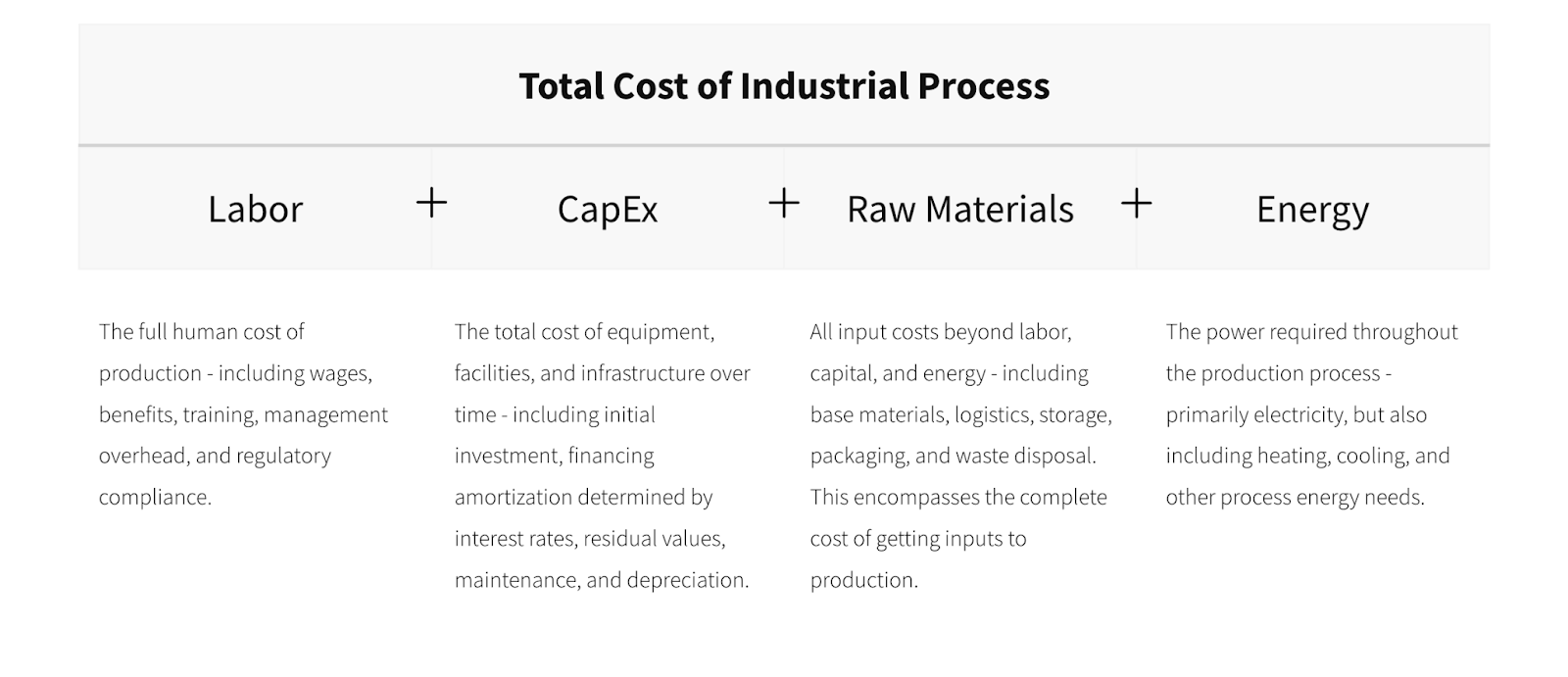
Manufacturing is governed by four forces: labor, capital expenditure, raw materials, and energy. Across the last three industrial transformations, the throughline is the systematic conversion of labor into capital. Steam centralized prime movers. Electrification distributed them. Mass production standardized work and pushed productivity through specialized tooling.
Beginning in the 1970s, the center of gravity shifted. Containerization, cheap digital communications, and trade liberalization made labor-price arbitrage the decisive variable. US firms rewired themselves from manufacturers into portfolio managers of outsourced Asian vendors. Lead times stretched to months. Inventory piled up to absorb the variance. In-house expertise in advanced manufacturing atrophied.
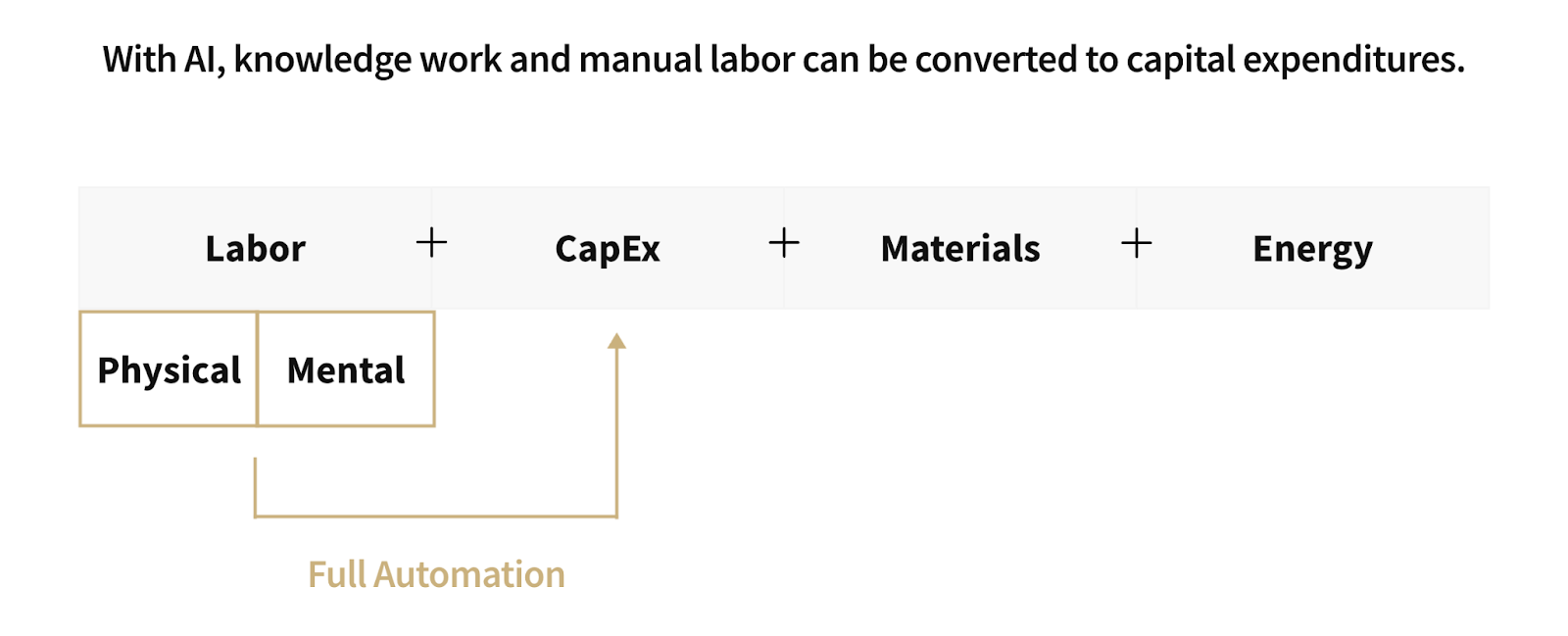
That is the world Framework is replacing. Transformer-based AI models can now perceive, plan, and act. Vision-language-action models translate natural-language goals, sensor streams, and CAD constraints into stepwise plans. Physical labor and mental labor can both be converted into capital expenditure at a depth that was not previously possible. Once labor is no longer the binding constraint, the optimization problem changes. The questions become: where is the cost of capital lowest, where are the materials, and where is the energy. In a growing list of categories, the answer to all three is the United States.
The Consumer Clothing Conundrum
If consumers want infinite variety, if businesses that scale most slowly with that variety win, and if industrial cost physics is being rewritten in a direction incumbents cannot follow, then one of the most exposed industries is the roughly $400B US consumer apparel market.
The country that is the world's largest apparel market and a top exporter of raw cotton imports roughly 98% of its finished apparel. Legacy brands hold up to 40% of assets in inventory to meet factory minimums and hedge six-month ocean lead times. Industry-wide, $70B to $140B sits in excess inventory at any given moment.
Meanwhile, consumer behavior has moved in the opposite direction. Zara and Shein flood the market with micro-batch styles that map shifting tastes in real time. Brands optimized for Asian outsourcing cannot match that variety or that speed without buying inventory they will then have to mark down.
This is the consumer clothing conundrum. Three things, pick two: low working capital, deep inventory, high SKU count. Legacy brands have parked themselves on the deep-inventory plus working-capital axis, and the cost is the long tail of consumer preference they fail to serve. Technology is breaking the triangle.
Framework: Software-Orchestrated Apparel Manufacturing
Framework is building automated apparel manufacturing in America. They software-orchestrated textile production and fulfillment, domestic, reliable, built for speed and scale.
The legacy supply chain is a chain of human-mediated handoffs strung across an ocean. Designs translate to spec sheets, spec sheets translate to factory instructions, factory instructions get executed by workers thousands of miles from the customer, finished goods sit in containers for weeks before reaching warehouses. Each handoff adds latency, working capital, forecast risk, and quality variance.
Framework optimizes that supply chain into a single domestic, software-orchestrated production system. Designs flow directly into machine instructions. Production triggers on demand. Fulfillment runs on the same digital backbone as production.
This is what makes Framework structurally different from a contract manufacturer that happens to be in the United States. Localizing production without rearchitecting the system around automation just produces an expensive version of the same offshore process. Framework is the inverse. Brands integrate with Framework the way modern internet businesses integrate with cloud infrastructure: design at the front end, capacity provisioned on demand at the back end, no inventory of finished goods stockpiled in between.
Backing the Builder of American Apparel
The American apparel base did not erode because consumers stopped wanting clothes, or because the country lost the raw materials. It eroded because the rules of cost physics for several decades made offshoring the rational answer, and every incumbent reorganized around that answer until they could no longer organize around anything else.
Those rules are changing. Once labor's marginal cost is automated toward zero, geographic arbitrage stops paying. Latency, working capital, and forecast error become the binding constraints, and those constraints favor manufacturing close to the customer. The country with the deepest capital markets, abundant raw cotton, and some of the lowest industrial energy prices in the developed world is positioned to win that fight. The only question is who builds the company that captures it.
We believe Framework is that company. Software-orchestrated, domestic, automated, and built from the ground up for the cost physics of the next era rather than the last one. Not a better offshore replacement. A different system entirely. The backbone of automated apparel manufacturing in America.