
Do you remember when you picked up a really good knife for the first time? Do you remember the moment the knife felt heavier than it should be? And then you trust it. Even before your first cut.
We savor that surprise — when the mind grasps and finds more than it ever expected. That surprise is one of the most reliable signals of quality we know. Cheap things are hollow. Quality is found when an object contains more than its surface could ever suggest on its own.
But the surprising heaviness of good things extends beyond what you can lift with your hand. We choose hotels by looking at photographs and subliminally count decisions. How many choices did someone make to design this room? Take the Ritz and Crosby Street Hotel in NYC, both five-star properties. Each room at the Ritz could be specified by a committee in an afternoon. The Crosby is pregnant with choices — the fabric in the headboard, its relationship to the pattern on the chair, the lamp, and even the book left under it.
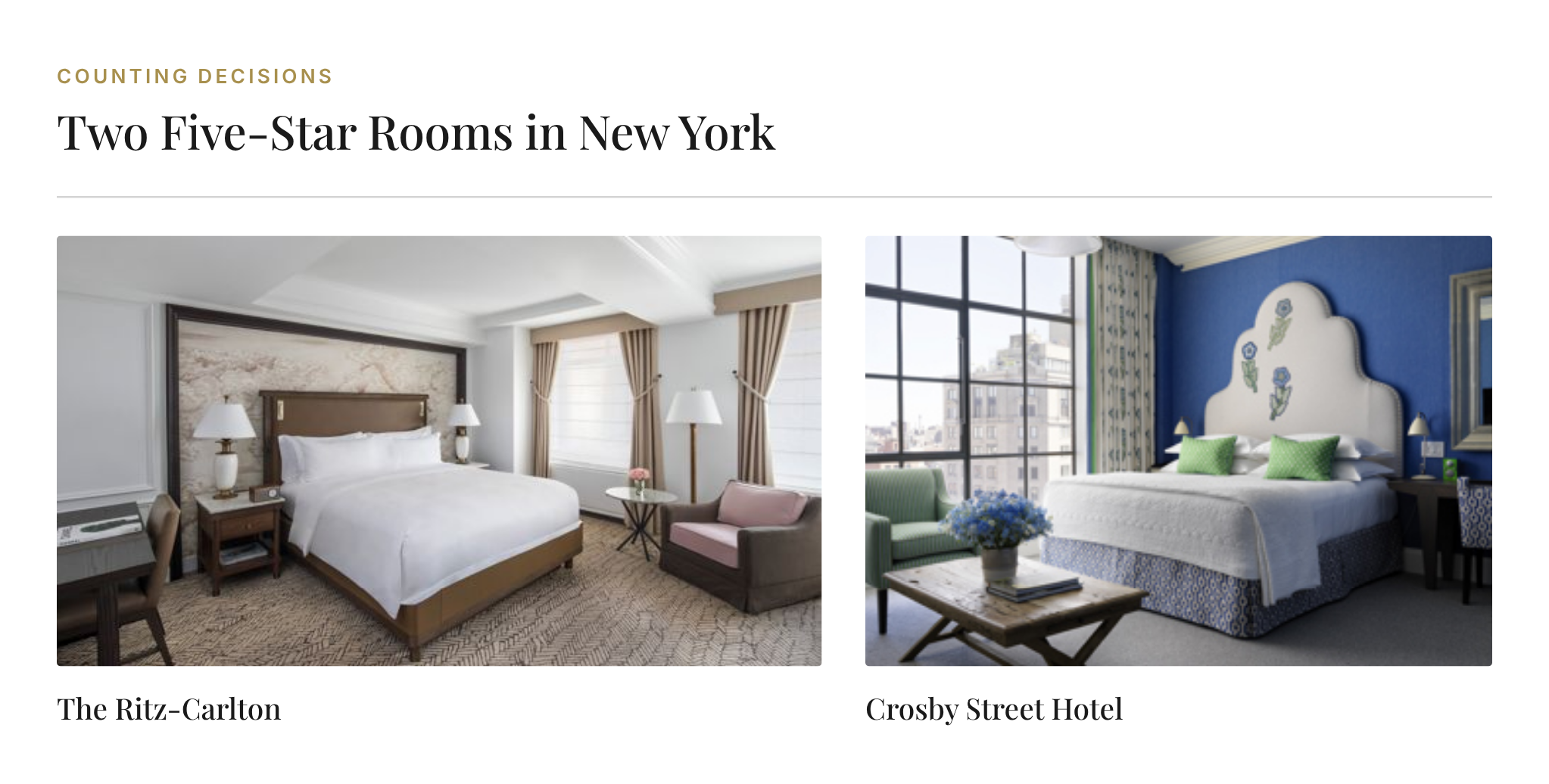
It is not just the decisions though. It's their coherence. After ten minutes in a room at The Crosby, you may be able to predict how the next one will make you feel without having any idea what it will actually look like. It is not that a fabric was chosen but a relationship between fabrics and books and lamps and chairs and pictures. There is a meta that you can feel.
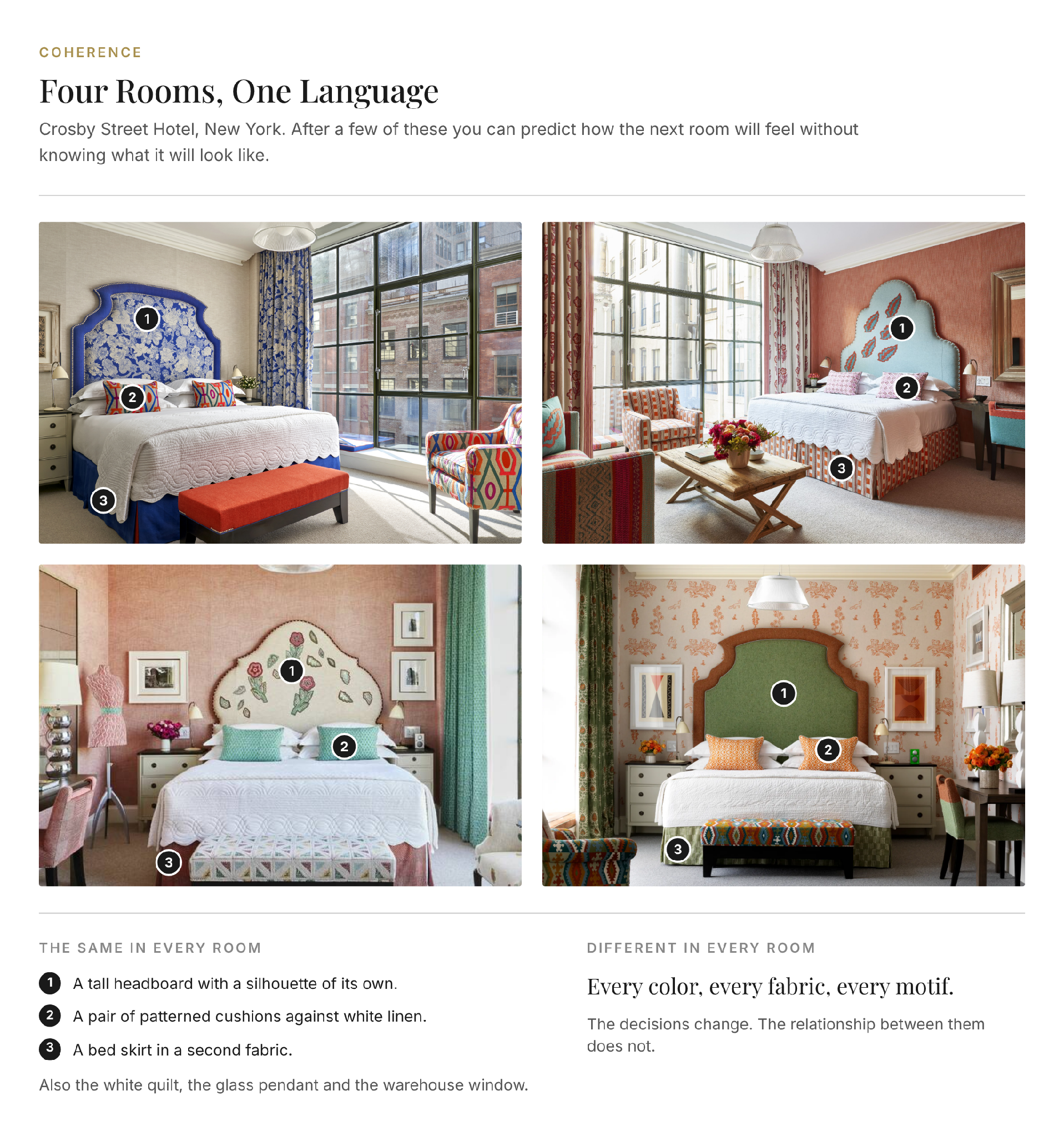
We call this density (hidden in abstract form). In observing and engaging with an object of interest, how much has been intentionally decided? How well do those decisions hold together (cohere)? Do they reveal a generative capacity to produce more coherent complexity over time? This type of density is not limited to hotel rooms either. It extends to people. And for us, specific people of interest, namely founders.
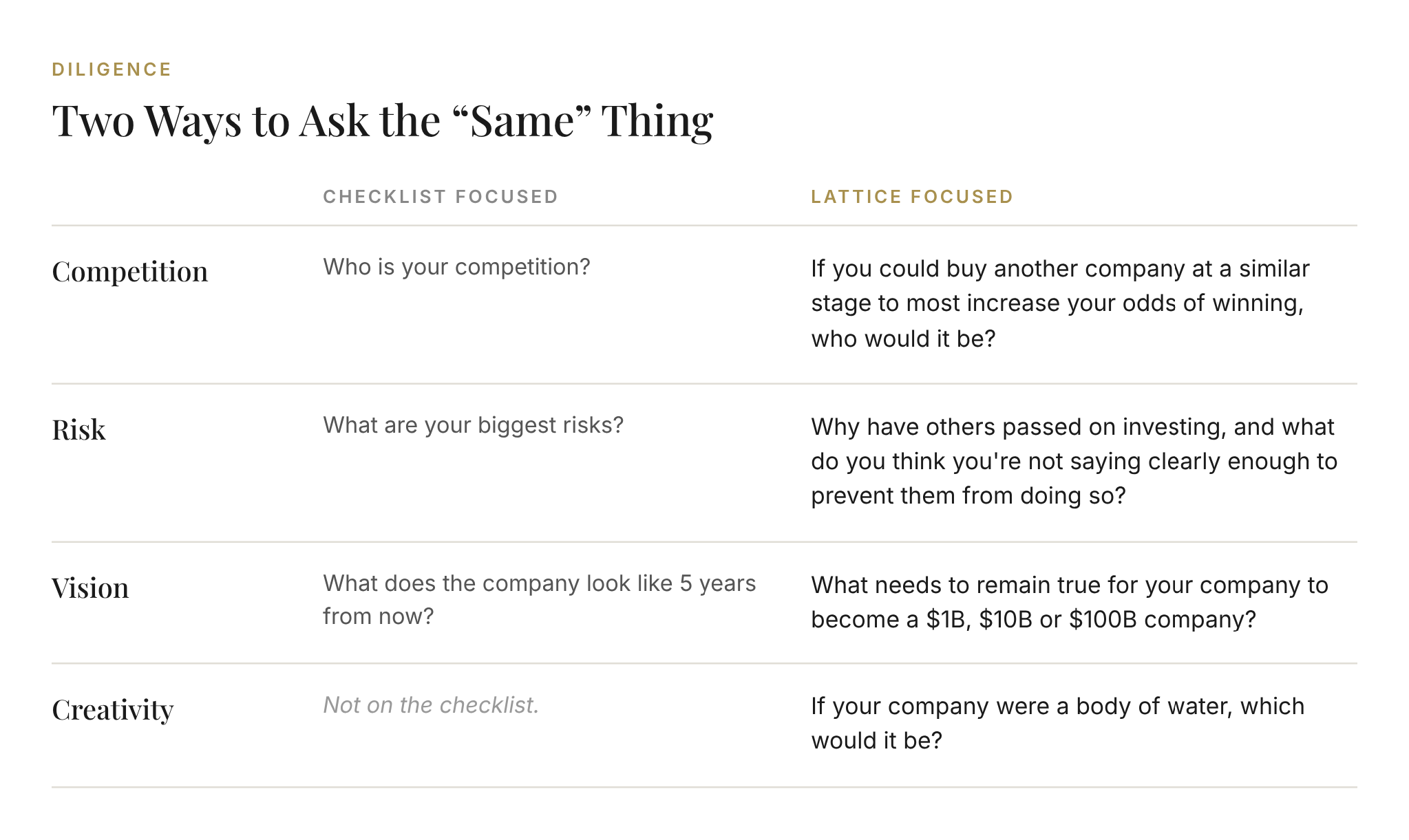
Have you ever spoken to a founder after they met with a checklist VC and then asked them real questions? You can feel them light up. A checklist asks about the product, business model, and market without ever touching the hidden structure that binds them together. Yes, those questions have good answers but their answers are the type a talented salesperson could produce. We want so much more.
We want to reveal the exact thing a checklist cannot find. We want to feel that heavy structure between things — that ties a person's decisions, actions, relationships, etc. together. Charlie Munger called this a latticework, the structure that facts and experience have to hang on before they are worth anything. That lattice is what we are trying to weigh. Like our knife, how do we pick a person up?
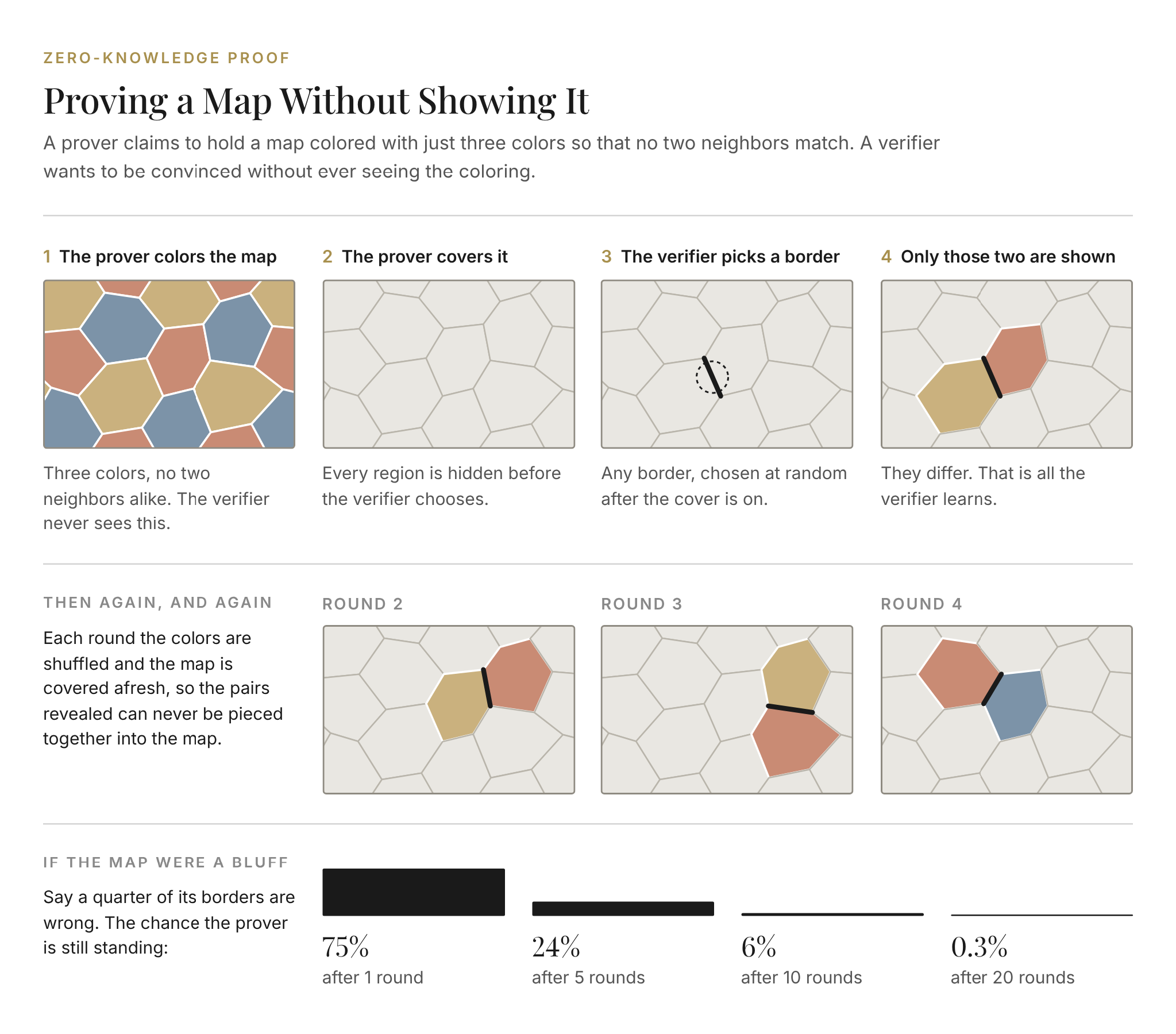
Luckily cryptographers have provided the shape of a solution — a zero-knowledge proof. This lets one party convince another that it knows something without handing all the knowledge over. The verifier (us) never witnesses the secret. The verifier asks question after question, each chosen at random. Someone who is bluffing may survive one. But the odds of surviving them all shrink with every round, until the only reasonable explanation is that there is real knowing there. Good diligence has this shape. Although we leave a day with Isaiah at Valar no more able to build a reactor than when we arrived, we do leave convinced that he can.
We hunger to find those people that carry in their mind more than just a route from A to B but rather the whole lattice that route runs through. Hearing a simple pitch is like walking an idealized route. It never survives contact with reality. That is why our palpation must seem random. We need to sample the lattice and the mind that holds it. The best of the best hunger for that contact. After all, action begets information.
So we also take action. Good diligence must break the fourth wall. We must move from face-to-face presentations to side-by-side explorations. A meal is three hours of playful provocation. A site visit is an opportunity to witness a desk, open a door that has been kept closed, see the unfinished and unpolished in the process of becoming. Have you ever played Monopoly with someone you are thinking of investing in?
Finally, we check whether the samples agree. How you do one thing, after all, is how you do everything. We should feel the lines that connect the founder who wrote those old essays and X posts to the one across the table joking with us at dinner to the one at the whiteboard with their team to the one selling a new potential customer. The same mind should show up at every depth. A hollow person changes with depth. A heavy one has coherence all the way down.
It is this very coherence within the individual that births the (collective) coherence of a team. This is often called culture. At Valar most of the team wears black Valar t-shirts and pants to the office. Yet no one requires them to. Rather, they mirror how Isaiah has shown up every day. Ask any engineer at Valar to choose between two designs and you hear Isaiah's voice — the one we can manufacture at scale. Real culture is what allows organizations to scale and pursue ever higher forms of complexity.
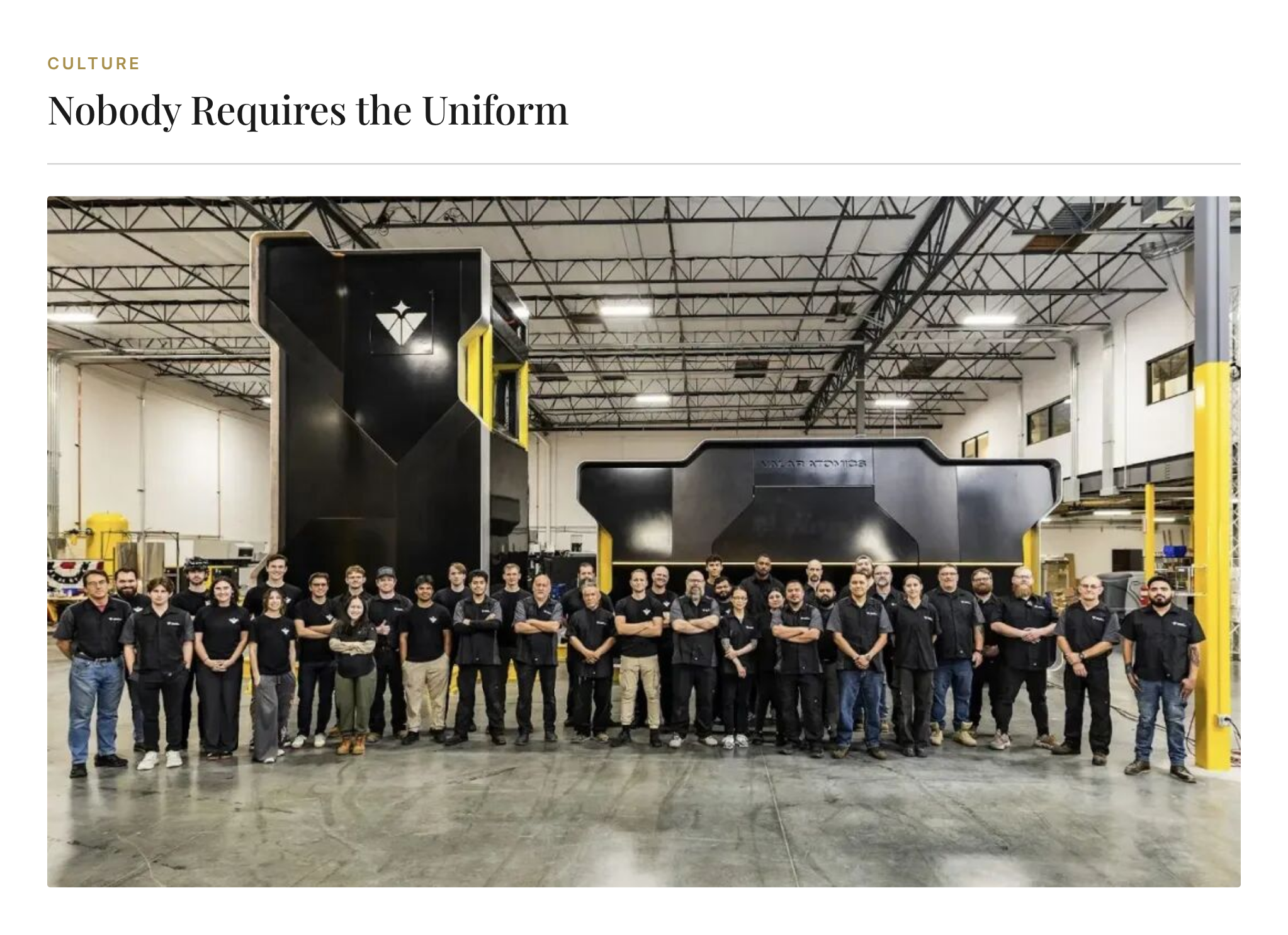
Most organizations, though, lack culture. They add people and the decisions stop cohering. So, rightly, they default to least common denominators (which is exactly how you get a five-star hotel room that feels like it was designed by committee). The great companies are inoculated against this by their founders. SpaceX took on harder and harder problems while becoming more and more recognizably itself.
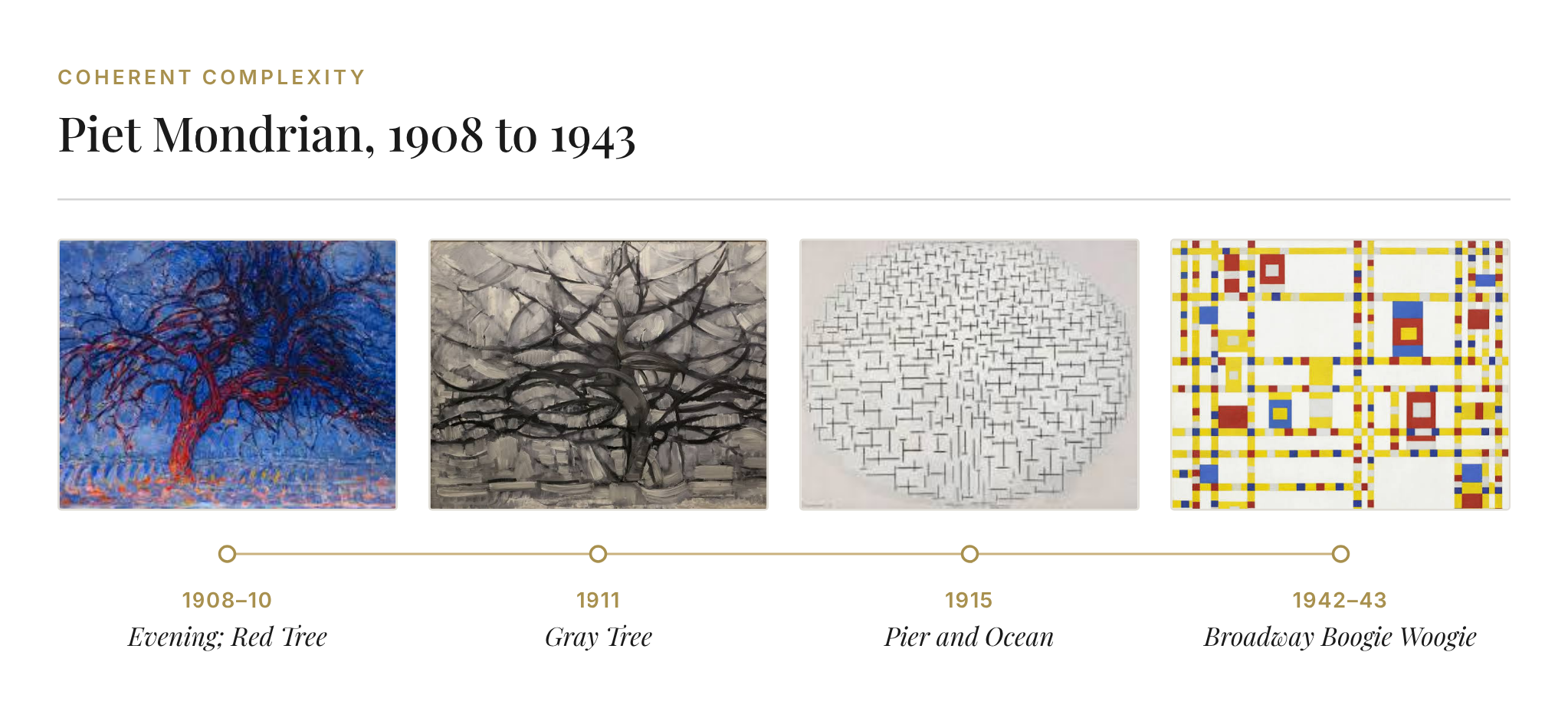
At the end of the day, our sampling is meant to understand whether the inner language of a founder's mind is strong enough to become the outer language of a team culture. We believe this is what creates companies that not only have first acts, but second and third acts too. We seek coherence that can nurture complexity. You can see this same capacity within the oeuvres of great artists. Their work grows more complex and more coherent all at once — until a single line is recognizably theirs.
Mondrian is a wonderful example. In ~19010 he was painting trees. Years pass and the branches begin to flatten into a lattice of lines. Then, by ~1915 the subject has dissolved. Essences have been revealed with short horizontal and vertical strokes. These strokes become grids and these grids become complex patterns of primary colors. Can you see Broadway Boogie Woogie (1942) in the Red Tree (1908)? Like a seed that contains a tree, was it there the whole time?
We believe probing these depths is more important than ever. The cost of producing a deck or a model or an answer to a checklist of questions is rapidly converging to zero and in doing so, so is their value. What still cannot be generated is the thing that the hand finds with a good knife — the hidden heaviness of a real perspective connected through real experience.
Our diligence is designed to weigh that lattice. And we love when those lattices are surprisingly heavy. This type of diligence takes time so we work with fewer companies than most. But we love our job picking things up and investing in the ones that are heavier than they might look to others.